















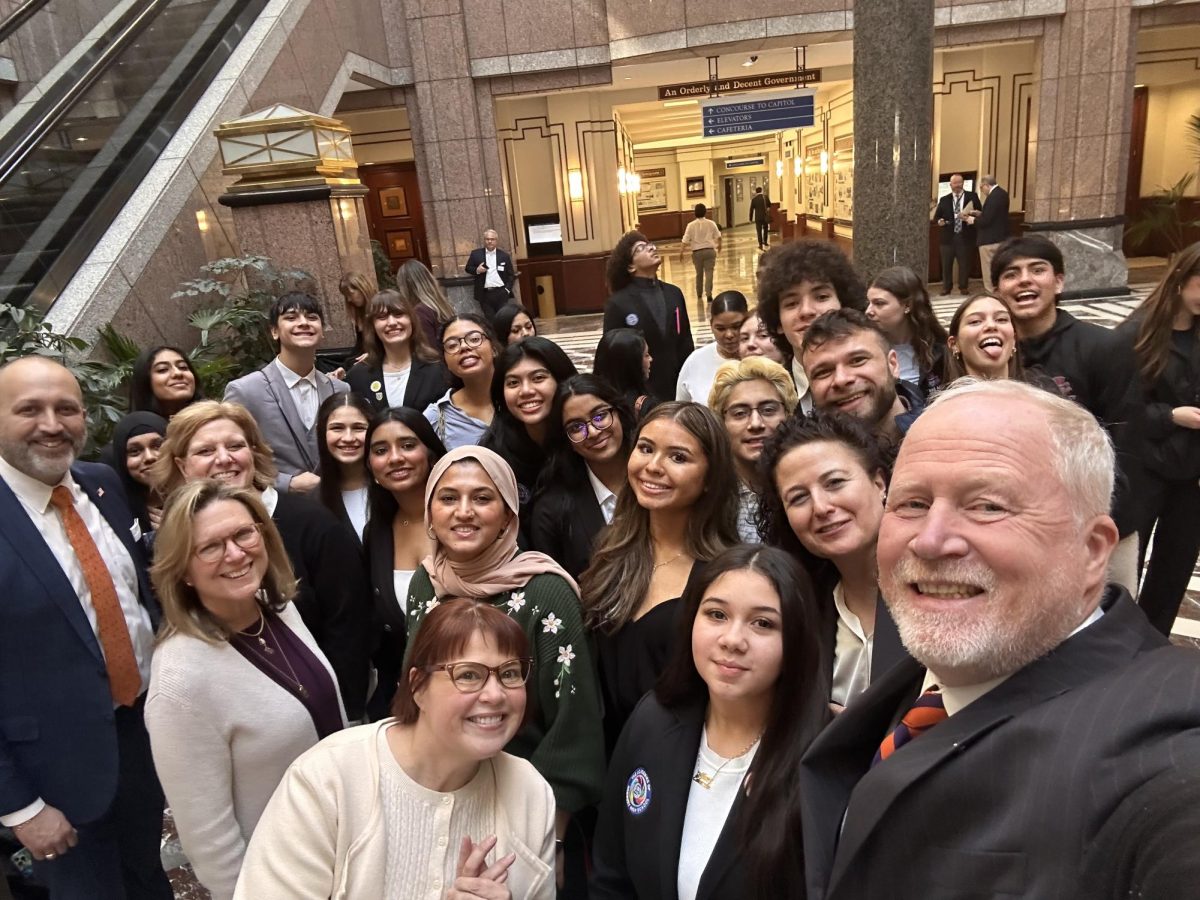
On March 4th, 2026, a group of Danbury students went to the State Capitol, ready to advocate for their school.
The students, led by DHS teacher and Mock Trial advisor Heather Lorenz, attended a public hearing held by the Connecticut General Assembly Education Committee. Where lawmakers heard testimony from educators, students, and community members about proposed education legislation.
The group came to support Connecticut Senate Bill 7, which proposes increasing funding through the state’s Education Cost Sharing Grant (ECS). The bill would gradually raise the ECS foundation amount, starting with an increase to $12,500 in the 2026–2027 school year and $13,500 in 2027–2028, with continued increases in the years that follow.
ECS was created in 1988 to help equalize funding between poorer and wealthier towns. Public education relies heavily on local property taxes, which means wealthier towns could spend much more on schools than poorer cities.
Students from Danbury, as well as surrounding Connecticut cities such as Hartford, Bridgeport, and New Britain, came to the capital to express the need for the ECS foundation cost to be raised.
The following excerpt from the Connecticut State Finance Project states: “The foundation in the ECS formula is $11,525 per student. However, this foundation amount is not based on any data or analysis of the actual costs associated with educating a general education student in Connecticut.”
“Additionally, the foundation amount is not adjusted to reflect the annual increase in expenses such as the rising costs of personnel pursuant to collective bargaining contracts, energy costs, or inflation. As a result, the current foundation amount has been in place, without adjustments, since 2013.”
If this ECS foundation price was adjusted for inflation and rising costs for education, the number today in 2026 would be over $16,000. Instead, ECS is still at the starting rate of $11,525, forcing students to advocate for their education.
Instead of schools receiving the funding necessary to maintain education in Connecticut, “this burden is falling on local districts,” Lorenz explained, emphasizing the need for increased State support.
Zuzana Barnovsky, a senior at Danbury High School, was one of the speakers that represented Danbury at the hearing on March 4th. When she prepared her speech to the Education Committee she wanted to make sure that “they weren’t hearing the perspective of a mayor or governor, I wanted to make my speech personal, showing what it really means to be a student in Danbury.”
Danbury was just ranked the 7th most diverse city in the United States of America, along with Danbury High School being the most populated high school in Connecticut with over 3,400 students.
Having the largest student population in Connecticut takes a toll on the educational budget for Danbury Public schools. Danbury schools were ranked 166/166 on expenditure costs, which means we spend the least amount of money on average per student in all of Connecticut.
Danbury’s PPE (Per Pupil Expenditure) average, based on a report from Fiscal Resources in 2024-2025 was $17,847. This means that the Danbury school district has an average of about $17,847 to spend per student.
This is the lowest PPE rate in Connecticut; with other schools such as Greenwich (which is the 2nd highest student population in Ct) having an average PPE of $29,025, and New Cannan (which is the #1 ranked school district in Ct in math and reading proficiency) with a PPE of $27,869.
These are the statistics state officials have heard time and time again. Yet behind the numbers is a reality that cannot be measured in data alone. “I see teachers taking money out of their own pockets to make sure their students have the resources they need.” Lorenz stated, showing the compassion teachers have in Danbury.
Lorenz added that “to be a teacher at Danbury High School teachers need to care about their students, I see teachers bringing food in for their students, because they know the school lunch may be one of the only meals they’re receiving.”
“It is more attractive to teach at a school where not only are you getting paid more, but the workload is easier, you don’t have to deal with Multilingual Students (MLS) or have 20 plus kids in a class.” Teachers are forced to wear many different hats, they must be an educator, translator, councilor, advocator, and a friend.
Education is the backbone of a community, and setting students up for success should be one of the highest priorities of both the state and the country. Increasing ECS funding would not just raise numbers on a budget sheet, it would provide real opportunities for students.
It could mean smaller class sizes, better resources, more support for multilingual learners, and fairer pay for teachers who are already giving so much of themselves.
For Danbury, increased funding is not about gaining an advantage, it’s about creating equity. It is about ensuring that students have access to the same quality of education as those in wealthier districts, regardless of a zip code.
The students who traveled to the State Capitol on March 4th demonstrated what it means to stand up for education. If change is to happen, it will not come from statistics alone, it will come from advocacy. Barnovsky echoes this thought, “if we want to see change, we must be willing to speak up for it.”